
Garage Door Spring Repair in Rochester, New York
Spring help in Rochester, New York starts by separating a spring fault from the parts that work with the spring: cables, drums, bearings, and the opener itself. The upstate winters, city tightness, and lake snow pattern across the state sets the wear, and as the fourth-largest city in the state the city has a wide mix of door ages and types, so a diagnosis that skips the cables and the balance test is guesswork, not a repair plan.
Call (877) 318-0816 — Same-Day Service Within 24 Hours in Rochester
Local conditions in Rochester
- New York is not one spring state but at least three: New York City's tight, urban garages, the Hudson Valley's humid summers and cold winters, and upstate lake-effect snow around Buffalo and Rochester.
- Each region ages springs differently, and a plan that treats the state as one climate will miss at least two of them.
- New York City garages are often compact, basement, or shared, with tight headroom that can rule out torsion conversion.
- Upstate homes commonly have insulated double doors for winter, and older upstate doors often carry extension springs whose safety cables need checking.
What spring adjustment and door balancing involves
Not every spring problem is a snap.
Adjustment changes the stored tension so the spring once again counterbalances the door's weight through its full travel.
A well-adjusted door opens evenly, closes without a thud, and does not drift when left halfway.
Spring Adjustment and Door Balancing — full service page
Symptoms to watch
The most telling sign here is a door that feels heavy, jerky, or unwilling to stay halfway open. Not every spring problem is a snap. If the door suddenly feels heavy, makes a loud bang, or shows a gap in a coil, stop using it, keep people and cars clear, and do not force it with the opener.
What to check first
- Check that both springs on a two-spring door match each other, because a mismatched pair lifts the door unevenly.
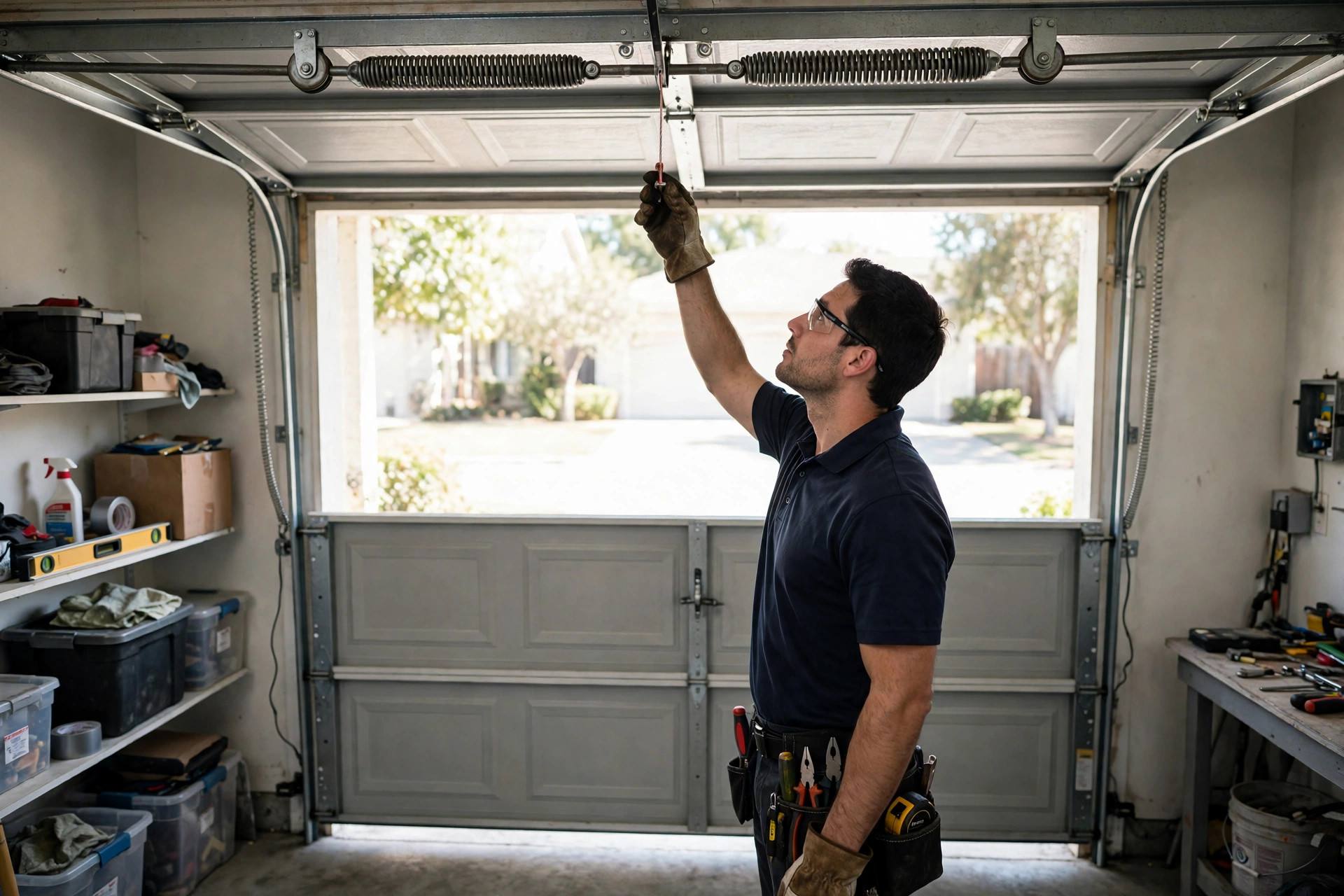
- Check that extension springs still have a safety cable through the centre of each spring, because a door should never run without that cable in place.
- Test the safety-reverse function after any spring work, so the door stops and reverses if it meets an obstruction.
- Check rollers, hinges, and bearings for dryness and grit before blaming the spring for every noise.
Questions people ask about garage door springs
Is spring replacement dangerous to do myself?
Yes. A spring counterbalances a door that sources put at roughly 130 to 400 pounds, and that weight's worth of energy is stored in the spring under tension even when the door is closed. Safe homeowner checks are the balance test, the safety-reverse test, a photo-eye check, lubrication, and visual checks; winding, unwinding, or adjusting tension belongs to a trained technician.
When is extension-to-torsion conversion worth discussing?
Conversion is worth discussing for older extension doors that keep breaking springs, doors where safety cables are missing or repeatedly damaged, and heavier doors that extension springs struggle to lift evenly. It needs enough headroom above the opening, one source cites a 12-inch minimum, and the door must be re-measured and re-balanced as a torsion door.
What is the balance test, and what does it tell me?
Disconnect the opener, lift the door by hand to waist height, and let go. A balanced door stays roughly where you leave it, while a door that falls, rises on its own, or needs real effort to move has a spring or balance problem that tension work should address.
Service promise: For garage door spring help in Rochester, New York, call (877) 318-0816 for same-day service — service within 24 hours, and the address on file is Florida Garage Door Company, 274 S Military Trail, Deerfield Beach, FL 33442.
Photos on this page are representative images, not verified photos of this business's own jobs.
Spring services most relevant here
- Spring Adjustment and Door Balancing
- Extension Spring Safety Cable Installation
- High-Cycle Spring Upgrade