
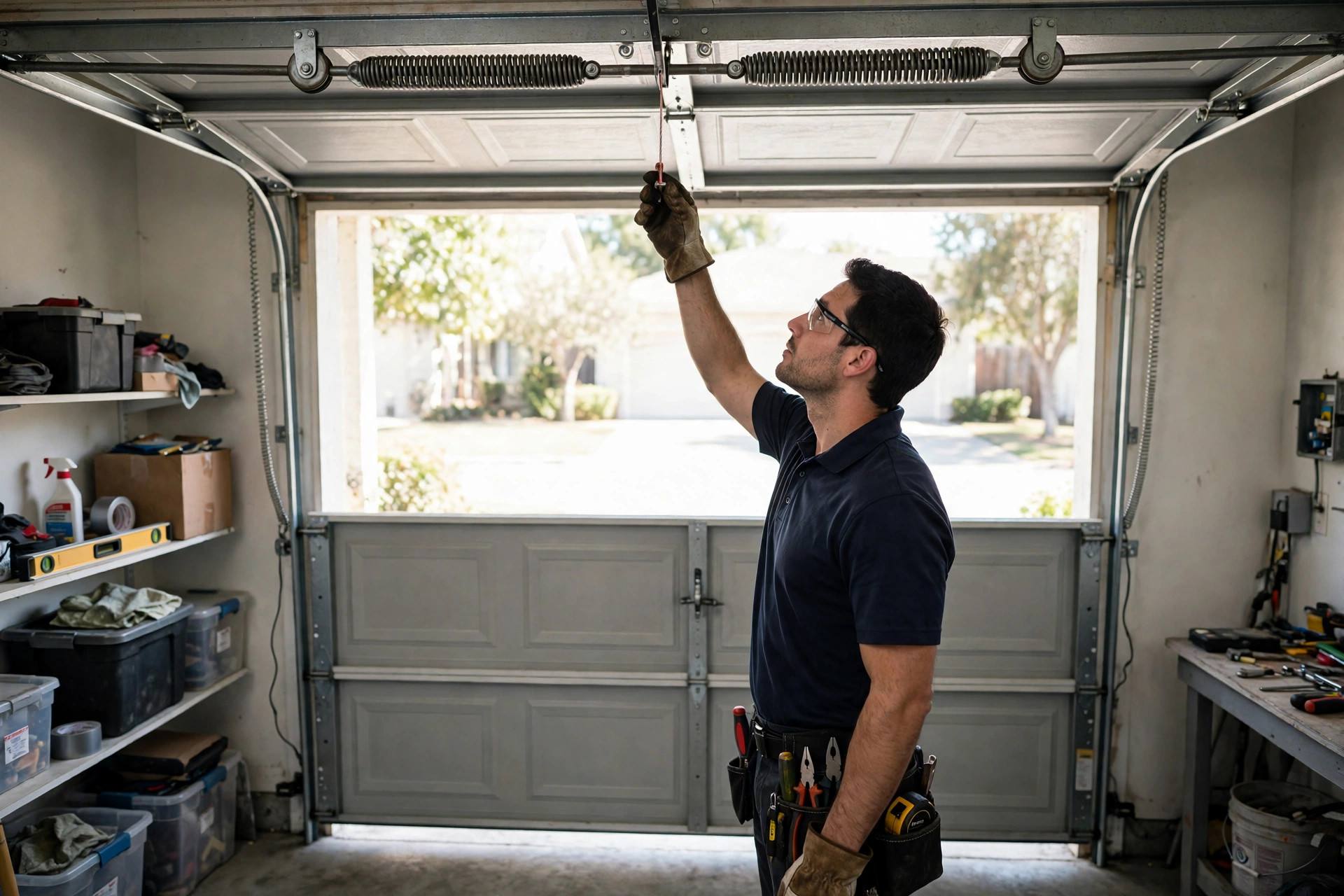
Garage Door Spring Repair in Rutland, Vermont
A broken garage door spring in Rutland, Vermont is usually a safety problem first and a repair second: the door can stop halfway, feel suddenly heavy, or trap a car inside. Spring wear here follows the long winters and rural detached garages pattern found across the state, and as the fourth-largest city in the state the city has both older doors with extension springs and newer doors on torsion shafts, so the first job is always to identify which system the door has.
Call (877) 318-0816 — Same-Day Service Within 24 Hours in Rutland
Local conditions in Rutland
- Vermont's long winters and rural detached garages put springs through months of cold in buildings that are often unheated and exposed to snow.
- A spring in a Burlington or rural Vermont detached garage faces a harsher winter than a spring in an attached, heated garage in a milder state.
- Vermont homes commonly have insulated doors for winter, beside older single doors in historic towns and larger rural garage doors.
- Vermont's insulated doors are heavier and need stronger springs, while its older doors often carry extension springs whose safety cables need checking.
What spring adjustment and door balancing involves
Not every spring problem is a snap.
Adjustment changes the stored tension so the spring once again counterbalances the door's weight through its full travel.
A well-adjusted door opens evenly, closes without a thud, and does not drift when left halfway.
Spring Adjustment and Door Balancing — full service page
Symptoms to watch
The most telling sign here is a door that feels heavy, jerky, or unwilling to stay halfway open. Not every spring problem is a snap. If the door suddenly feels heavy, makes a loud bang, or shows a gap in a coil, stop using it, keep people and cars clear, and do not force it with the opener.
What to check first
- Check the coil surface for dull, pitted rust, especially on the lower coils nearest the floor.
- Check the balance at waist height with the opener disconnected, and note whether the door stays put, falls, or rises on its own.
- Listen for a loud bang, popping, or grinding, then check whether the door lifts evenly or leads with one side.
- Check cables for fraying or slack where they wind onto the drums, because a worn cable can mimic a spring failure.
Questions people ask about garage door springs
What is the difference between torsion and extension springs?
A torsion spring sits on a shaft above the door and twists to store energy, while extension springs run along the side tracks and stretch as the door closes. Torsion systems generally lift more evenly because one shaft drives both sides together, while extension systems need a safety cable through each spring because a snapped extension spring can whip.
Why does my door lift crookedly?
A door that lifts with one side higher than the other is lifting unevenly, which can mean a spring mismatch, pulley wear, or cable slack rather than an opener fault. An extension system only lifts evenly when both sides pull together, so the cause has to be found before the door is forced again.
Why replace both springs when only one broke?
On a two-spring door both springs have shared every open and close since they were fitted, so the surviving spring has already used up almost the same number of cycles. Replacing only the broken one leaves a new spring working beside a tired one, and that mismatch is a common cause of uneven lift and a second breakdown weeks later.
Service promise: For garage door spring help in Rutland, Vermont, call (877) 318-0816 for same-day service — service within 24 hours, and the address on file is Florida Garage Door Company, 274 S Military Trail, Deerfield Beach, FL 33442.
Photos on this page are representative images, not verified photos of this business's own jobs.
Spring services most relevant here
- Spring Adjustment and Door Balancing
- Extension Spring Safety Cable Installation
- High-Cycle Spring Upgrade