
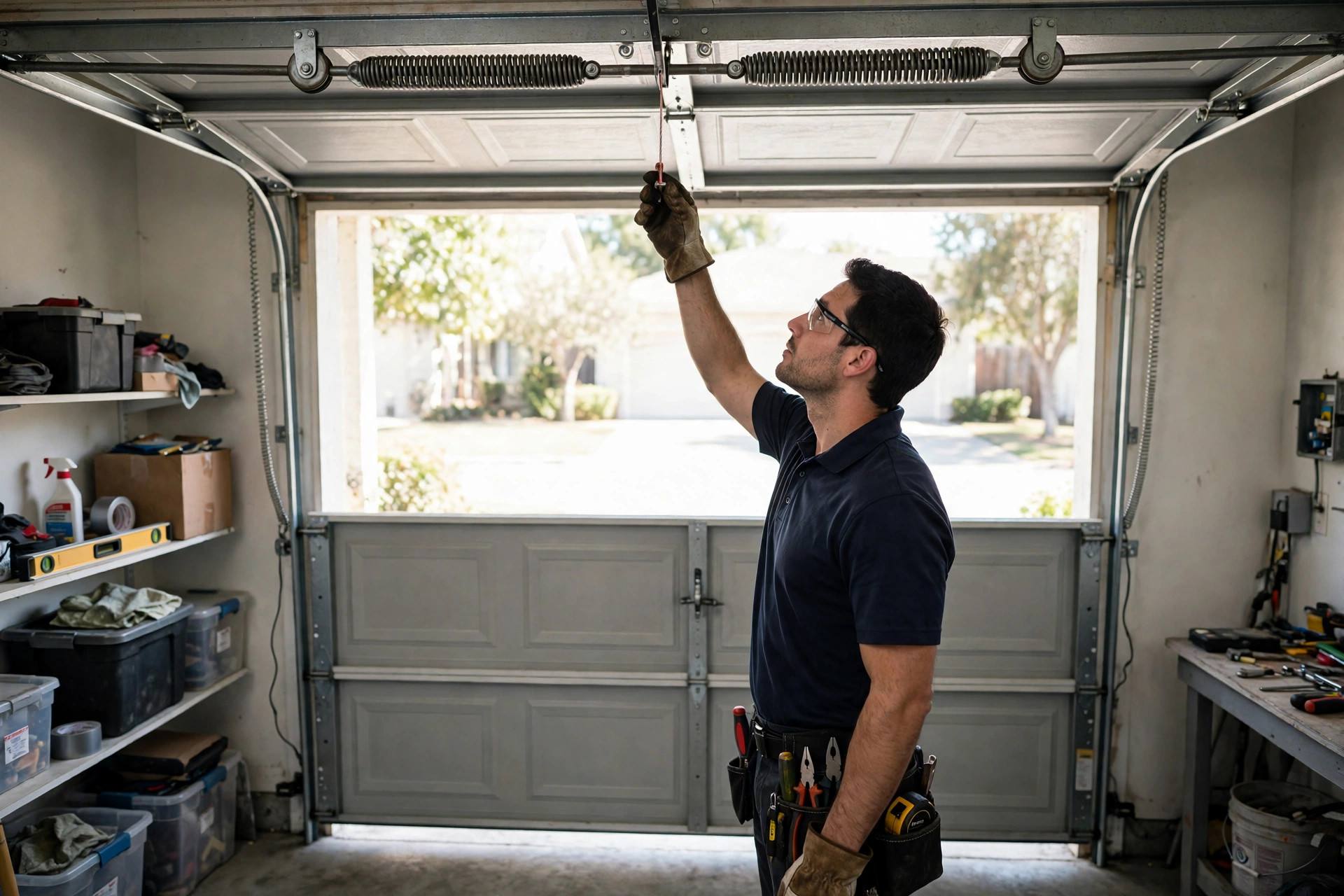
Garage Door Spring Repair in Kenosha, Wisconsin
A broken garage door spring in Kenosha, Wisconsin is usually a safety problem first and a repair second: the door can stop halfway, feel suddenly heavy, or trap a car inside. Spring wear here follows the lake winters, road salt, and long cold seasons pattern found across the state, and as the fourth-largest city in the state the city has both older doors with extension springs and newer doors on torsion shafts, so the first job is always to identify which system the door has.
Call (877) 318-0816 — Same-Day Service Within 24 Hours in Kenosha
Local conditions in Kenosha
- Wisconsin's lake winters and road salt are among the harshest spring conditions in the Midwest: months of cold, salt tracked into garages, and lake humidity in summer adding a second rust season.
- Milwaukee and Madison homes face the same pattern at different severities, with northern Wisconsin's winter lasting longest.
- Wisconsin homes commonly have insulated, heavy doors for winter, beside older single doors in historic neighbourhoods.
- Wisconsin's heavy insulated doors need stronger springs, and its older doors often carry extension springs whose safety cables need checking.
What spring adjustment and door balancing involves
Not every spring problem is a snap.
Adjustment changes the stored tension so the spring once again counterbalances the door's weight through its full travel.
A well-adjusted door opens evenly, closes without a thud, and does not drift when left halfway.
Spring Adjustment and Door Balancing — full service page
Symptoms to watch
The most telling sign here is a door that feels heavy, jerky, or unwilling to stay halfway open. Not every spring problem is a snap. If the door suddenly feels heavy, makes a loud bang, or shows a gap in a coil, stop using it, keep people and cars clear, and do not force it with the opener.
What to check first
- Look for a visible gap in a coil, rust or pitting on the springs, and slack or frayed cables before using the opener again.
- Check whether insulation or a heavier panel has outgrown the original spring rating.
- Check whether the door closes without slamming and stays open halfway, which is the quick sign of lost tension.
- Check headroom above the door before discussing a torsion conversion, since a low opening may not fit a shaft system.
Questions people ask about garage door springs
Why does my door slam shut?
A door that slams shut, will not stay open halfway, or needs real effort to move has usually lost spring tension or balance. Lubrication of dry rollers, hinges, and bearings can help a jerky door, but lubrication alone will not fix a door whose springs have lost their tension.
What does an inspection check that I cannot see myself?
An inspection looks for the early warnings a snap has not yet given: a coil gap, rust or corrosion on the spring, frayed or slack cables, a missing safety cable on an extension door, and a door that fails the balance test. Rollers, hinges, and bearings are checked and lubricated, and the visit ends with a plain list of what is safe, what needs work soon, and what needs work now.
How long do garage door springs last?
Spring life is rated in cycles, not calendar years: one cycle is one open plus one close, and standard residential springs are commonly rated around 10,000 cycles. At three to five cycles a day that is roughly five to seven years, at one to two a day it can stretch past a decade, and at eight a day it can halve to under four years.
Service promise: For garage door spring help in Kenosha, Wisconsin, call (877) 318-0816 for same-day service — service within 24 hours, and the address on file is Florida Garage Door Company, 274 S Military Trail, Deerfield Beach, FL 33442.
Photos on this page are representative images, not verified photos of this business's own jobs.
Spring services most relevant here
- Spring Adjustment and Door Balancing
- Extension Spring Safety Cable Installation
- High-Cycle Spring Upgrade